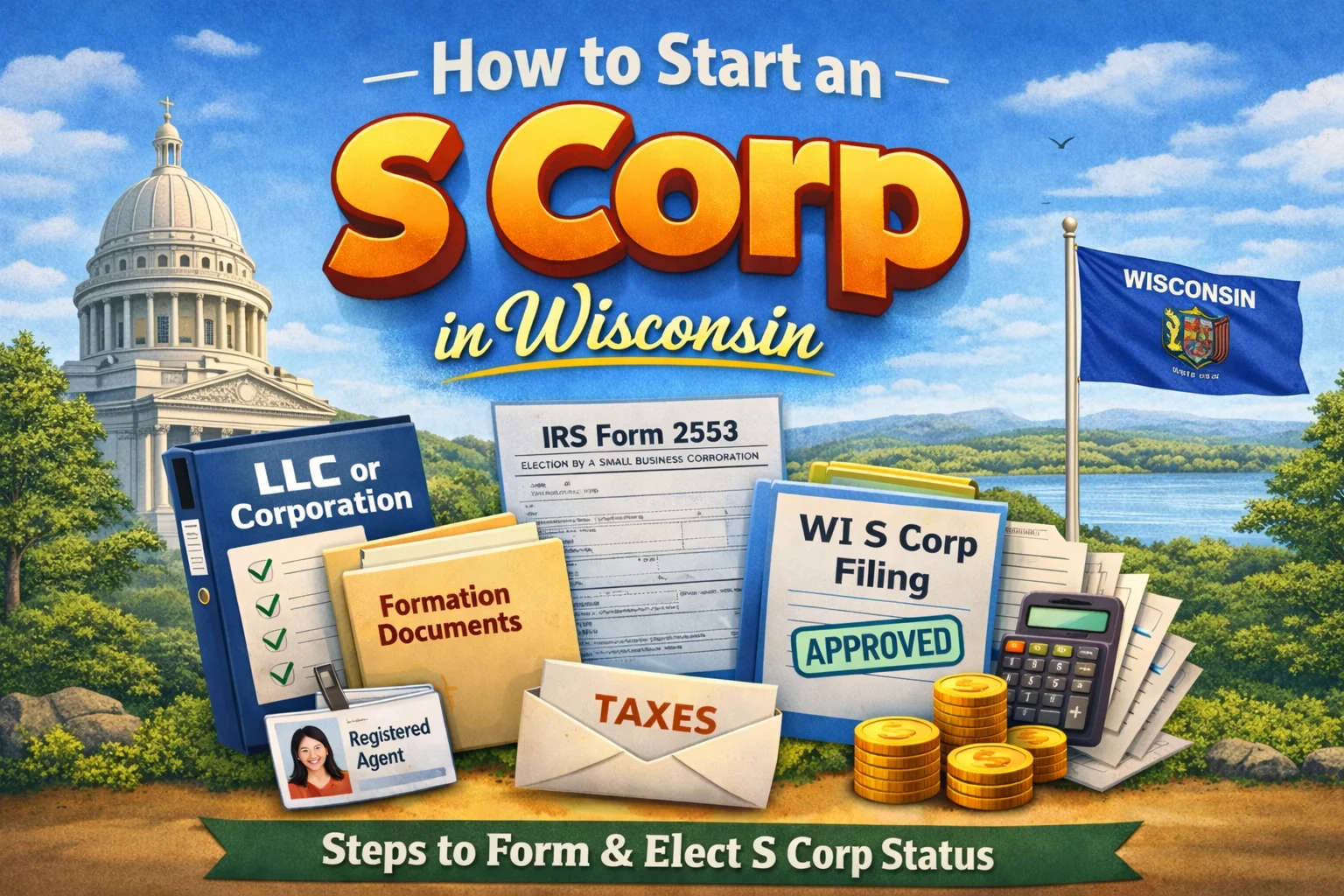
1. Introduction to S Corporations in Wisconsin
An S Corporation (commonly called an S Corp) is a special tax status
granted by the
Internal Revenue Service (IRS) that allows eligible businesses to pass income, losses,
deductions,
and credits directly to shareholders for federal tax purposes. In Wisconsin, an S Corp
is not a
separate legal entity type but a tax election made after forming a corporation or LLC.
To operate as an S Corp in Wisconsin, a business must first be legally formed with the
Wisconsin Department
of
Financial Institutions (DFI) and then file IRS Form
2553 to elect S Corporation
status. Once approved, the business remains subject to both federal S Corp rules and
Wisconsin
state tax and compliance requirements.
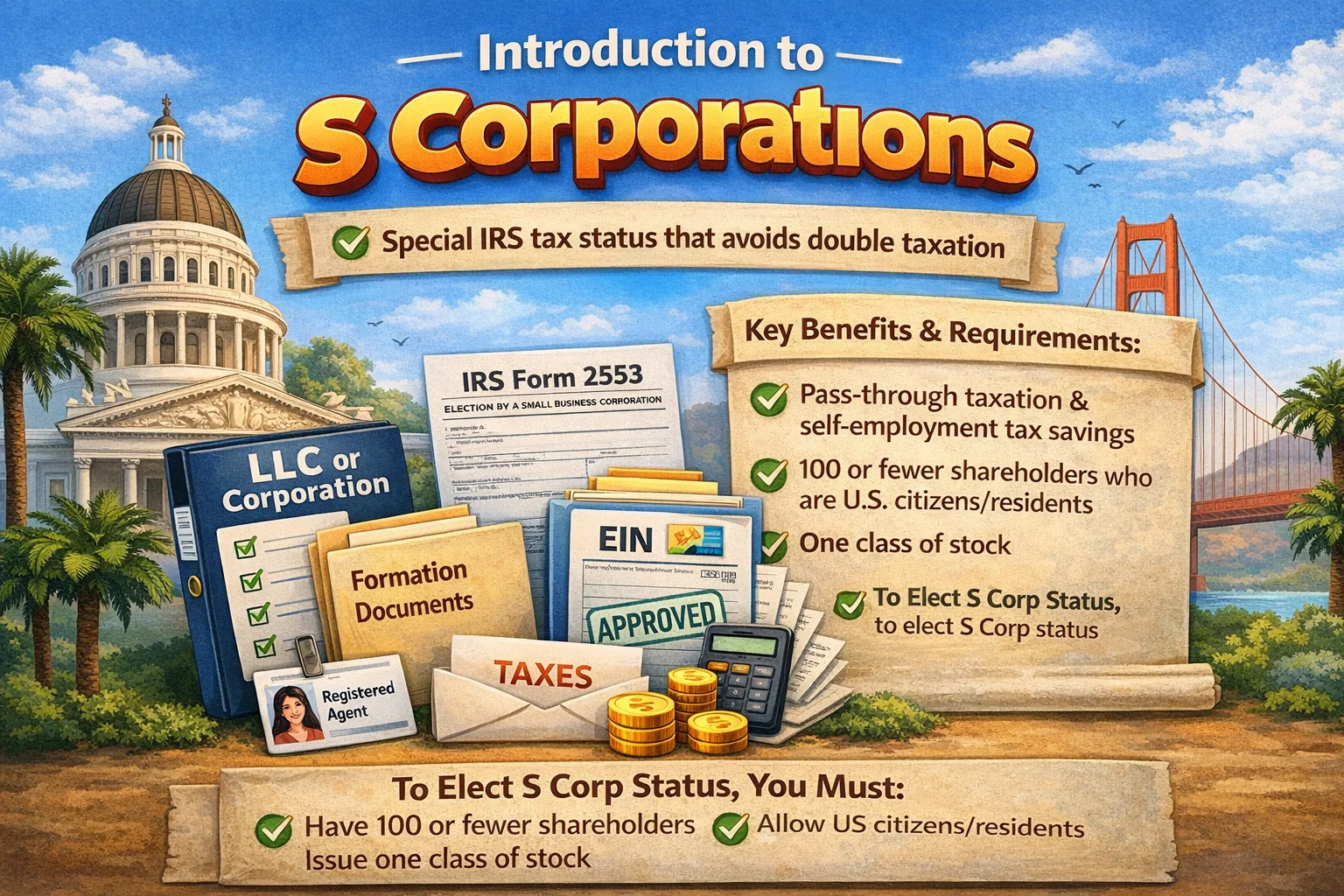
2. Benefits of Starting an S Corp in Wisconsin
Starting an S Corporation in Wisconsin can offer significant tax and operational advantages for eligible businesses. While the company must still comply with Wisconsin corporate and tax rules, S Corp status is commonly chosen by business owners looking to optimize taxation while maintaining liability protection and professional credibility.
Key benefits of forming an S Corp in Wisconsin
- Pass-through taxation: Business income and losses pass directly to shareholders and are reported on individual tax returns, avoiding federal corporate income tax
- Potential payroll tax savings: Owners who work in the business can receive part of their income as distributions, which are not subject to self-employment tax
- Limited liability protection: Shareholders are generally not personally responsible for business debts or legal obligations
- Improved business credibility: S Corporations are often viewed as more established by banks, vendors, and potential investors
- Predictable ownership structure: S Corps allow up to 100 shareholders and require a single class of stock, creating clarity in ownership and profit distribution
3. Eligibility Rules for Wisconsin S Corporations
To start and maintain an S Corporation in Wisconsin, a business must meet strict eligibility requirements set by the Internal Revenue Service (IRS) and comply with applicable Wisconsin regulations. Businesses that fail to meet these requirements may be denied S Corp status or have their election automatically terminated.
Core eligibility requirements for S Corp status
- Domestic entity requirement: the business must be formed in the United States as a corporation or LLC registered with the Wisconsin Department of Financial Institutions (DFI)
- Shareholder limitations: the S Corp may have no more than 100 shareholders
- Eligible shareholders only: shareholders must generally be U.S. citizens or resident individuals; most corporations, partnerships, and non-resident owners are not allowed
- Single class of stock: the business may issue only one class of stock, meaning all shares must have identical rights to distributions and liquidation proceeds
- Approved business type: certain businesses, such as insurance companies and some financial institutions, are not eligible for S Corporation status
- Timely IRS election: IRS Form 2553 must be filed and accepted within the required election period
Meeting all eligibility rules is essential for preserving S Corporation status. If an S Corp violates IRS requirements—such as issuing multiple classes of stock or adding an ineligible shareholder—the IRS may revoke the S Corp election, resulting in higher taxes and compliance complications.
4. Wisconsin S Corp Fees & Costs
Wisconsin offers relatively predictable and transparent business formation costs. While S Corporations must file annual reports, state taxes are generally based on income rather than a flat minimum fee.
| Service / Requirement | Remarks | Fee / Cost |
|---|---|---|
| Articles of Incorporation (Formation) | Filed online with the Wisconsin Department of Financial Institutions | $100 (online & paper) |
| Registered Agent Service i | Professional service (optional but common) | $50 / year (varies by provider) |
| EIN (Employer Identification Number) | Free from the IRS (online application) | $0 |
| Wisconsin State Income Tax | Paid by shareholders on pass-through income (S Corp informational return only) | 3.54% – 7.65% (graduated rates) |
| Bylaws / Shareholder Agreement | Recommended internal document (not filed with state) | $0 – $200 ($0 with FormLLC) |
Why Use a Professional Agent?
- Enhanced privacy for owners
- Compliance and filing reminders
- Reliable handling of legal notices
Using a professional service like FormLLC can help you streamline your Wisconsin S Corp formation and EIN process, while ensuring a compliant Operating Agreement is included at no extra cost. Register now to get started.
Always look beyond just the “formation price”. The real cost includes annual reports, registered agent renewals, tax filings, and error correction. A complete setup can prevent costly compliance issues later.
READY TO START YOUR WISCONSIN S CORP?
Get step-by-step guidance on forming your business, filing IRS Form 2553, and handling Wisconsin-specific tax and compliance requirements to start your S Corporation the right way and avoid costly mistakes.
Start My Wisconsin S Corp5. Complete Formation Process for a Wisconsin S Corp
Starting an S Corporation in Wisconsin is a two-step process. First, the business must be legally formed as a corporation or LLC with the Wisconsin Department of Financial Institutions (DFI). Second, the business must elect S Corporation tax status by filing the required election with the Internal Revenue Service (IRS). Completing each step in the correct order is critical to ensure the S Corp is valid and compliant.
- Form a Wisconsin business entity: register a corporation or LLC with the Wisconsin Department of Financial Institutions (DFI) and receive confirmation of formation
- Create internal governing documents: prepare corporate bylaws or an operating agreement outlining ownership, voting rights, and management structure
- Obtain an Employer Identification Number (EIN): apply for an EIN from the IRS to identify the business for tax and payroll purposes
- Issue ownership interests: issue shares (for corporations) or membership interests (for LLCs) and document ownership percentages
- Elect S Corporation status: file IRS Form 2553 within the required timeframe to request S Corp tax treatment
- Register for Wisconsin tax accounts: enroll with the appropriate state agencies for payroll, employment, and other applicable taxes
- Open a business bank account: separate personal and business finances by opening a dedicated business bank account
6. Filing IRS Form 2553 for S Corp Status
Filing IRS Form 2553 is required to be taxed as an S Corporation. Even after forming a corporation or LLC in Wisconsin, the business is not treated as an S Corp until the IRS approves this election.
What is IRS Form 2553?
IRS Form 2553 is used to elect S Corporation tax status, allowing business income to pass through to shareholders instead of being taxed at the corporate level.
When should Form 2553 be filed?
- New businesses: Within 75 days of formation
- Existing businesses: By March 15 of the tax year
- Late filings: May be accepted with reasonable cause
Key information required
- Business legal name and EIN
- Date and state of formation
- Ownership details and shareholder signatures
- Selected tax year
7. Annual Filings and Ongoing Compliance Requirements
After forming a Wisconsin S Corporation, you must stay compliant with both the Wisconsin Department of Financial Institutions (DFI) and the Wisconsin Department of Revenue. Missing filings or deadlines can result in penalties or loss of good standing.
Required Wisconsin filings
- Annual Report: Filed with the Wisconsin Department of Financial Institutions
- Form 5S: Annual Wisconsin S Corporation franchise and income tax return
- State tax payments: Due based on taxable income, if applicable
Federal requirements
- IRS Form 1120-S: Federal S Corporation tax return
- Schedule K-1: Issued to shareholders
- Payroll filings: Required for shareholder-employees
Corporate maintenance
- Maintain corporate records and governing documents
- Document shareholder and director decisions
- Keep accurate financial and payroll records
- Update registered agent and address information
FormLLC can help manage annual filings, track deadlines, and keep your Wisconsin S Corporation compliant year after year.
8. Conclusion
Starting an S Corporation in Wisconsin can offer meaningful tax and operational advantages, but only when the business is formed and managed correctly. From entity formation and IRS S Corp election to Wisconsin franchise taxes, payroll setup, and ongoing compliance, each step plays an important role in long-term success.
By understanding Wisconsin-specific requirements and maintaining proper filings each year, business owners can avoid penalties, protect their good standing, and maximize the benefits of S Corp taxation. If you want expert guidance at any stage of the process, FormLLC can help you start and maintain your Wisconsin S Corporation with confidence and clarity.
9. Frequently Asked Questions
A Wisconsin S Corporation is a business that elects S Corp tax status with the IRS, allowing profits and losses to pass through to shareholders’ personal tax returns while operating as a corporation or LLC under Wisconsin law.
To start an S Corp in Wisconsin, you must first form a corporation or LLC with the Wisconsin Department of Financial Institutions, obtain an EIN from the IRS, and then file IRS Form 2553 to elect S Corporation tax status.
Yes. Filing IRS Form 2553 is required to be taxed as an S Corporation. Without this election, the business will be taxed under its default federal classification.
No. Wisconsin does not impose a flat minimum franchise tax. S Corporations may owe state tax based on net income and must file the required returns with the Wisconsin Department of Revenue.
Yes. Shareholders who actively work in the S Corporation must be paid a reasonable salary that is subject to payroll taxes before taking profit distributions.
Wisconsin S Corporations must file an annual Annual Report with the Department of Financial Institutions, Form 5S with the Wisconsin Department of Revenue, and IRS Form 1120-S at the federal level.
Yes. FormLLC can assist with Wisconsin S Corp formation, IRS S Corp election, payroll setup, and ongoing compliance to help you start and manage your business correctly from day one.