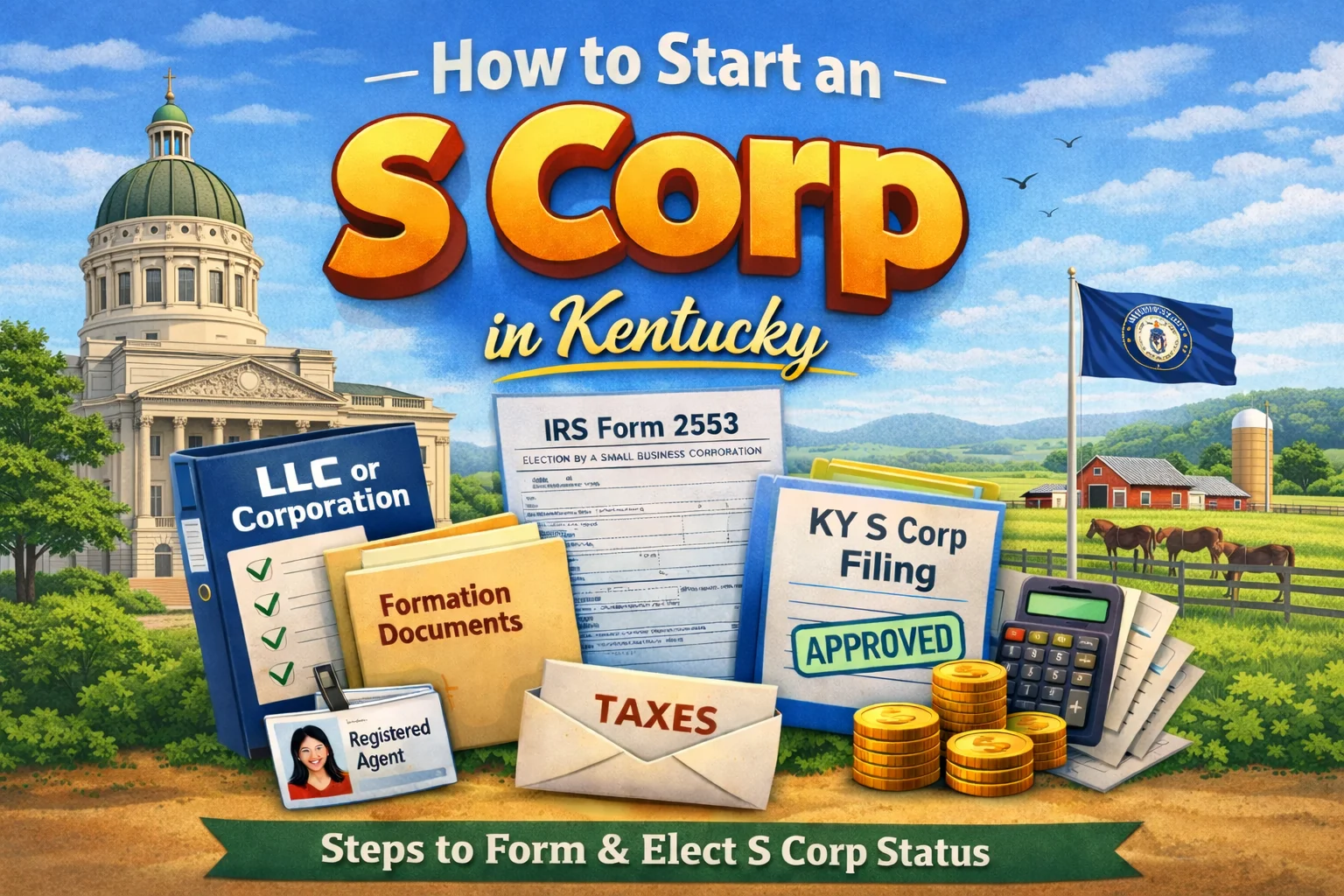
1. Introduction to S Corporations in Kentucky
An S Corporation (commonly called an S Corp)
is a special tax status granted by the Internal Revenue
Service (IRS) that allows eligible businesses to pass income,
losses, deductions, and credits directly to shareholders for
federal tax purposes. In Kentucky, an S Corp is not a separate
legal entity type but a tax election made after forming a
corporation or LLC.
To operate as an S Corp in Kentucky, a business must first be
legally formed with the
Kentucky
Secretary of State
through the official Fast Track
Filing portal, and then file IRS Form 2553 to elect S
Corporation status. Once approved, the business remains
subject to both federal S Corp rules and Kentucky state tax and
compliance requirements.
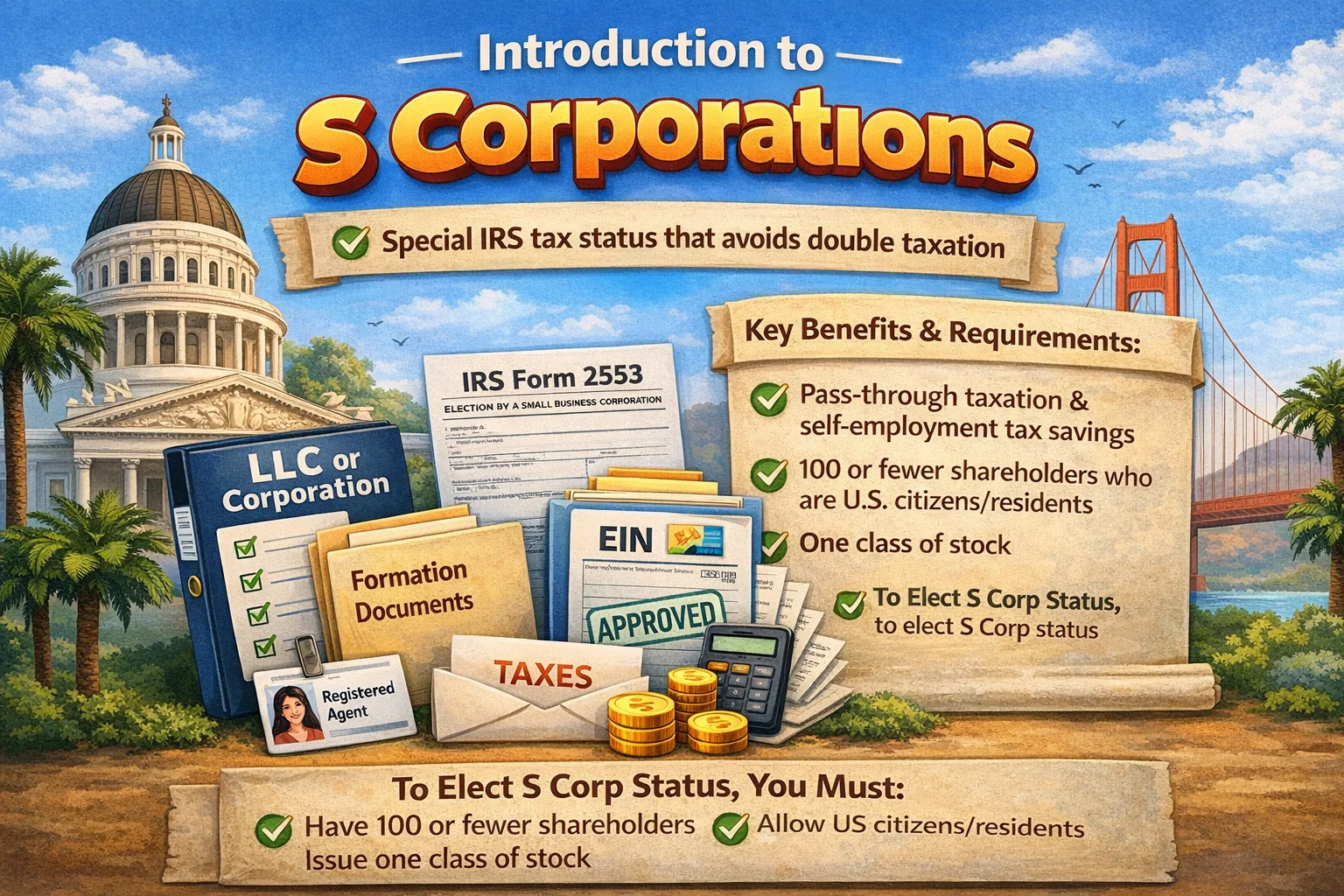
2. Benefits of Starting an S Corp in Kentucky
Electing S Corporation status in Kentucky can provide meaningful tax advantages, liability protection, and enhanced credibility for eligible businesses. However, these benefits apply only when federal IRS requirements and Kentucky state compliance rules are properly followed.
Key benefits of forming an S Corp in Kentucky
- Pass-through taxation: An S Corporation does not pay federal corporate income tax at the entity level. Instead, business income, losses, deductions, and credits pass directly to shareholders and are reported on their individual federal and Kentucky income tax returns.
- Potential payroll tax savings: Owner-employees must take a reasonable salary (subject to payroll taxes), but additional profits may be distributed as dividends. These distributions are generally not subject to self-employment tax, which can reduce overall tax liability compared to sole proprietorships or partnerships.
- Kentucky state tax treatment: Kentucky uses a flat individual income tax rate (currently 4%) for personal income. S Corporation profits pass through to shareholders and are taxed at the individual level. The S Corp itself does not pay Kentucky corporate income tax, though it must file informational returns and may be subject to other state-level taxes or fees depending on business activity.
- Limited liability protection: Shareholders are generally protected from personal liability for business debts, contracts, and legal claims, provided corporate formalities are maintained.
- Enhanced business credibility: Operating as a corporation can improve perception with banks, investors, vendors, and clients, often making it easier to secure financing or contracts.
- Structured ownership rules: S Corporations may have up to 100 shareholders, must issue only one class of stock, and are limited to eligible shareholders (generally U.S. individuals and certain trusts and estates), providing a clear and predictable ownership structure.
3. Eligibility Rules for Kentucky S Corporations
To qualify for and maintain S Corporation status in Kentucky, the business must meet strict federal eligibility rules set by the Internal Revenue Service (IRS), while also complying with Kentucky formation and ongoing requirements. Failure to meet these rules can result in denial of S Corp status or automatic revocation.
Core eligibility requirements for S Corp status
- Domestic corporation: The business must be a domestic (U.S.-formed) corporation. It is typically formed with the Kentucky Secretary of State through the official Fast Track Filing portal. (LLCs may qualify if they elect corporate taxation.)
- Shareholder limit: No more than 100 shareholders are allowed.
- Eligible shareholders: Shareholders must be U.S. citizens, U.S. resident aliens, certain trusts, or estates. Most corporations, partnerships, and non-resident aliens are not permitted.
- Single class of stock: Only one class of stock is allowed—all shares must have identical rights to distributions and liquidation proceeds.
- Permitted business types: Certain businesses (such as most insurance companies and specified financial institutions) are ineligible for S Corporation status.
- Timely election: File and have IRS Form 2553 accepted within the required timeframe (generally within 2 months and 15 days after the start of the tax year for new entities).
Meeting and maintaining all IRS eligibility rules is critical. Violations—such as adding an ineligible shareholder, issuing a second class of stock, or exceeding the shareholder limit—can cause the IRS to revoke S Corp status, leading to higher taxes and increased compliance burdens.
4. Kentucky S Corp Fees & Costs
Kentucky offers straightforward and relatively low-cost business formation. S Corporations benefit from pass-through taxation federally. Kentucky recognizes the federal S election, so there is no corporate income tax at the entity level on pass-through income—shareholders pay Kentucky personal income tax on their share of income at the state's flat rate (4% for 2025; reduced to 3.5% effective January 1, 2026). However, S Corporations are subject to the Kentucky Limited Liability Entity Tax (LLET), an entity-level tax based on Kentucky gross receipts or gross profits (minimum $175).
| Service / Requirement | Remarks | Fee / Cost |
|---|---|---|
| Articles of Incorporation (Formation) | Filed online with the Kentucky Secretary of State via the Fast Track Filing portal | $40 (plus organization tax if applicable, often minimal) |
| Registered Agent Service i | Professional service (optional but common) | $50 / year (varies by provider) |
| EIN (Employer Identification Number) | Free from the IRS (online application) | $0 |
| Kentucky Limited Liability Entity Tax (LLET) | Entity-level tax on S Corps (minimum applies; based on KY gross receipts or gross profits) | Minimum $175 (higher based on formula) |
| Kentucky State Personal Income Tax | Paid by shareholders on pass-through income (S Corp files informational return only) | Flat rate: 4% (2025); 3.5% (effective 2026) on shareholder's share |
| Bylaws / Shareholder Agreement | Recommended internal document (not filed with state) |
$0 – $200 ($0 with professional assistance) |
Why Use a Professional Registered Agent?
- Enhanced privacy (keeps your personal address off public records)
- Automatic compliance reminders and filing support
- Reliable handling of legal documents and service of process
Proper setup helps manage ongoing costs, including the annual report filed with the Secretary of State.
Look beyond the initial formation fee. Ongoing Kentucky costs can include the annual report ($15 for profit corporations), registered agent renewals, LLET payments, personal income tax filings, and occasional correction fees. Proper setup from the beginning avoids costly compliance issues later.
READY TO START YOUR KENTUCKY S CORP?
Get expert step-by-step help forming your business, filing IRS Form 2553, and meeting all Kentucky tax and compliance requirements—so you launch correctly and avoid expensive mistakes.
Start My Kentucky S Corp5. Complete Formation Process for a Kentucky S Corp
Starting an S Corporation in Kentucky involves two main phases: first, legally form the business as a corporation with the state, then elect S Corporation tax status with the IRS. Following the steps in order is essential for validity and compliance.
- Form a Kentucky corporation: File Articles of Incorporation with the Kentucky Secretary of State through the official Fast Track Filing portal and receive confirmation of formation. (While LLCs can elect S Corp taxation, most businesses form a corporation first.)
- Create internal governing documents: Prepare corporate bylaws (or a shareholder agreement) that outline ownership, voting rights, management structure, and other internal rules.
- Obtain an Employer Identification Number (EIN): Apply for a free EIN from the IRS online at irs.gov for tax, banking, and payroll purposes.
- Issue ownership interests: Issue stock certificates (for corporations) or membership interests (for LLCs) and document each owner’s percentage and rights.
- Elect S Corporation status: File IRS Form 2553 (Election by a Small Business Corporation) and have it accepted within the required timeframe.
- Register for Kentucky state taxes: Register with the Kentucky Department of Revenue for withholding tax accounts (for payroll), sales/use tax if applicable, and any other required state tax obligations.
- Open a business bank account: Open a dedicated business bank account to keep personal and business finances separate (most banks require your EIN, formation documents, and bylaws).
6. Filing IRS Form 2553 for S Corp Status
Filing IRS Form 2553 is required to be taxed as an S Corporation. Even after forming a corporation or LLC in Kentucky, the business is not treated as an S Corp until the IRS approves this election.
What is IRS Form 2553?
IRS Form 2553 is used to elect S Corporation tax status, allowing business income to pass through to shareholders instead of being taxed at the corporate level.
When should Form 2553 be filed?
- New businesses: Within 75 days of formation
- Existing businesses: By March 15 of the tax year
- Late filings: May be accepted with reasonable cause
Key information required
- Business legal name and EIN
- Date and state of formation (Kentucky)
- Ownership details and shareholder signatures
- Selected tax year
7. Annual Filings and Ongoing Compliance Requirements
After forming a Kentucky S Corporation, you must stay compliant with both the Kentucky Secretary of State and the Kentucky Department of Revenue. Missing filings or deadlines can result in penalties or loss of good standing.
Required Kentucky filings
- Annual Report: Filed annually with the Kentucky Secretary of State (due by June 30 each year; fileable January 1–June 30)
- Kentucky Form 720S (S Corporation Income Tax and LLET Return): Filed with the Kentucky Department of Revenue (informational return; includes payment of the Limited Liability Entity Tax (LLET))
- State tax compliance: Kentucky generally follows federal S Corporation pass-through treatment for income tax purposes (shareholders report income on personal returns), but S Corporations must pay the entity-level Limited Liability Entity Tax (LLET) and may be required to withhold tax or file composite returns on behalf of nonresident shareholders
Federal requirements
- IRS Form 1120-S: Federal S Corporation tax return
- Schedule K-1: Issued to shareholders
- Payroll filings: Required for shareholder-employees
Corporate maintenance
- Maintain corporate records and governing documents
- Document shareholder and director decisions
- Keep accurate financial and payroll records
- Update registered agent and address information
FormLLC can help manage annual filings, track deadlines, and keep your Kentucky S Corporation compliant year after year.
8. Conclusion
Starting an S Corporation in Kentucky provides valuable federal tax advantages through pass-through taxation, along with limited liability protection and professional credibility—provided the business is formed and managed correctly.
By following the proper steps—from forming the entity with the Kentucky Secretary of State, electing S Corp status via IRS Form 2553, setting up payroll, and handling Kentucky tax and compliance obligations—you can minimize risks, avoid penalties, and build a strong foundation for long-term success. Kentucky generally follows federal S Corp rules, with income passing through to shareholders who report and pay personal state income tax.
If you want expert help navigating the process, from formation to ongoing maintenance, FormLLC can guide you to start and keep your Kentucky S Corporation compliant and successful.
9. Frequently Asked Questions
An S Corporation in Kentucky is a corporation (or eligible LLC) that has elected S Corporation tax status with the IRS. This allows business income, losses, deductions, and credits to pass through to shareholders’ personal tax returns, while the business maintains limited liability protection under Kentucky law.
First, form a corporation (or LLC) with the Kentucky Secretary of State through the official Fast Track Filing portal . Next, obtain an EIN from the IRS and file IRS Form 2553 within the required timeframe to elect S Corporation tax status.
Yes. IRS Form 2553 must be filed and approved for your business to receive S Corporation tax treatment. Without this election, the business will be taxed under its default federal classification (typically as a C Corporation).
Kentucky does not impose a traditional franchise tax on S Corporations. However, S Corps may be subject to the Kentucky Limited Liability Entity Tax (LLET), depending on gross receipts or gross profits thresholds. In addition, shareholders pay Kentucky’s flat individual income tax rate (currently 4%) on their share of S Corp income.
Yes. Shareholders who actively work in the business must pay themselves a reasonable salary subject to payroll taxes before taking profit distributions. The IRS requires this to ensure payroll taxes are properly paid.
Kentucky S Corporations must file a Annual Report each year (due by June 30) with the Kentucky Secretary of State, submit Form 1120-S to the IRS along with Schedule K-1s for shareholders, and file Form K-120S with the Kentucky Department of Revenue. Additional payroll or LLET filings may apply depending on business activity.
Yes. FormLLC assists with Kentucky business formation, EIN registration, IRS Form 2553 filing, payroll setup, and ongoing compliance support to help you properly establish and maintain your S Corporation.